Important: This page is for informational purposes only, based on published peer-reviewed research and official UK dietary guidelines (NHS, EFSA, SACN). It does not constitute medical advice. Always consult your GP or pharmacist before starting, stopping, or combining supplements.
Ashwagandha and Panax Ginseng — Can You Take Them Together?
Overview
Ashwagandha (Withania somnifera) and Panax ginseng are two of the most extensively studied adaptogenic herbs, yet they operate through markedly different neurochemical pathways. Ashwagandha is broadly classified as a calming adaptogen — its active constituents modulate GABAergic signalling and blunt cortisol output. Panax ginseng, by contrast, is regarded as a stimulating adaptogen, with ginsenosides influencing catecholamine and monoamine neurotransmission. Rather than straightforward synergy or clear incompatibility, research suggests their opposing neuromodulatory profiles may interact in timing-dependent ways. Understanding how and when to take each may be as consequential as whether to combine them at all.
How They Interact
The mechanistic divergence between the two herbs is most apparent at the neurochemical level. Ashwagandha's active constituents have demonstrated direct activity on ionotropic GABAA and GABAρ receptors in preclinical models, providing a pharmacological basis for the calming and sleep-supporting effects commonly reported by users (Candelario et al., 2015, J Ethnopharmacol; PMID 26068424). Separately, randomised controlled trial evidence confirms that standardised ashwagandha root extract significantly reduces serum cortisol levels, consistent with downregulation of the hypothalamic-pituitary-adrenal (HPA) axis (Chandrasekhar et al., 2012, Indian J Psychol Med; PMID 23439798). Panax ginseng's ginsenosides engage a contrasting set of pathways. Research indicates that ginsenoside Rb1, a major active constituent, modulates serotonergic, noradrenergic, and dopaminergic neurotransmission — catecholamine systems broadly associated with arousal, alertness, and motivated behaviour (Li et al., 2017, J Ethnopharmacol; PMID 28412215). Taken simultaneously, these opposing neuromodulatory actions — GABAergic and HPA-dampening versus catecholaminergic activation — may partially attenuate one another's intended effects. The net outcome is likely unpredictable, and individual responses may vary considerably.
Timing & Dosage Guidance
A pragmatic protocol commonly explored in adaptogen literature involves chronological separation: taking Panax ginseng in the morning to support alertness and cognitive function during active hours, and ashwagandha in the evening to facilitate the body's natural cortisol decline ahead of sleep. This approach seeks to leverage each herb's distinct temporal profile rather than creating competing neurochemical signals. Robust clinical evidence specifically for this split-dose strategy remains limited; the rationale is primarily mechanistic and observational. Individual responses may vary, and those with sensitivity to stimulants or sedating compounds are advised to begin at lower doses and monitor their response before combining both herbs.
Neither herb carries an established Recommended Dietary Allowance (RDA) under UK or EFSA guidelines. Clinical trials on ashwagandha have most commonly used 300–600 mg of standardised root extract (such as KSM-66 or Sensoril) once or twice daily. Panax ginseng trials have typically employed 200–400 mg of a standardised extract providing 4–7% ginsenosides; some fatigue-focused trials used up to 1–2 g of a less concentrated preparation (Kim et al., 2013, PLoS One; PMID 23613825). When using both herbs concurrently, beginning at the lower end of each herb's clinically studied dose range is a sensible approach. Individuals taking prescribed medicines — particularly anticoagulants, antidiabetic agents, or thyroid medications — are strongly advised to consult a GP or pharmacist before combining these supplements.
Recommended Action
Some protocols use ginseng in the morning (for energy) and ashwagandha in the evening (for relaxation). Combining both at the same time may produce unpredictable results.
Ashwagandha Timing
When: Evening
Note: Evening preferred for stress/sleep. Can be taken morning for energy/endurance. With food to avoid GI discomfort.
Panax Ginseng Timing
When: Morning
Note: Morning with food. Stimulating — avoid evening use. Consider cycling (8 weeks on, 2 weeks off) to maintain efficacy.
Scientific Evidence
4 peer-reviewed studies cited. All links lead to PubMed abstracts.
Indian Journal of Psychological Medicine (2012) · PMID: 23439798
KSM-66 ashwagandha (300 mg twice daily) significantly reduced serum cortisol levels and perceived stress scores compared to placebo over 60 days, consistent with HPA axis modulation.
Journal of Ethnopharmacology (2015) · PMID: 26068424
Aqueous ashwagandha root extract demonstrated direct activity on GABAA receptors in Xenopus oocyte models, providing a mechanistic basis for the herb's calming and sleep-supporting properties.
PLoS One (2013) · PMID: 23613825
Panax ginseng at 1–2 g/day significantly improved mental fatigue scores over four weeks in adults with idiopathic chronic fatigue, with 2 g producing the strongest effect on visual analogue scale measures.
Journal of Ethnopharmacology (2017) · PMID: 28412215
Ginsenoside Rb1 produced behavioural antidepressant-like effects mediated primarily through modulation of serotonergic, noradrenergic, and dopaminergic neurotransmitter systems, illustrating ginseng's catecholaminergic mechanism of action.
Frequently Asked Questions
Research suggests taking both herbs simultaneously may be less effective than staggering them, as their neurochemical actions appear to work in opposing directions. Ashwagandha promotes GABAergic calm and cortisol suppression, whilst ginseng's ginsenosides activate catecholaminergic pathways associated with alertness. A morning dose of ginseng paired with an evening dose of ashwagandha is a protocol sometimes explored in adaptogen literature, though direct clinical trial evidence for this specific combination remains limited. Individual responses may vary.
Both herbs have broadly favourable safety profiles at doses used in clinical trials. However, Panax ginseng may interact with anticoagulants, antidiabetic agents, and certain monoamine-affecting medications. Ashwagandha is not recommended during pregnancy and may influence thyroid hormone levels with prolonged use. Using both herbs concurrently adds complexity to any potential medication interactions. Consultation with a GP or pharmacist is advisable for anyone managing a long-term health condition or taking prescribed medicines.
The most clinically researched ashwagandha extracts are KSM-66 (root only, standardised to ≥5% withanolides) and Sensoril (root and leaf, standardised to ≥10% withanolide glycoside conjugates). For Panax ginseng, standardised extracts providing 4–7% ginsenosides are generally preferred over raw root powder for more consistent dosing. Choosing clinically studied extract types at investigated dose ranges makes it easier to draw meaningful comparisons with published trial evidence. Individual responses may vary depending on extract type, dose, and timing.
Top Ashwagandha Products on AIScored
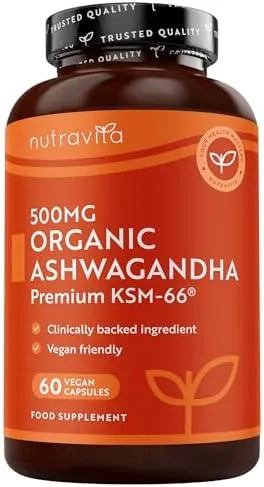
Nutravita Organic Ashwagandha KSM-66® 500mg - Premium Full-Spectrum Root Extract - Naturally Occurring Withanolides - 60 Vegan Capsules – Certified Organic Ashwagandha Supplement - Made in the UK


Shilajit Gummies with 50% Fulvic Acid & Ashwagandha - Energy Support & Brain Health
Top Panax Ginseng Products on AIScored
Q+A Zinc PCA Daily Moisturiser (75ml), Hydrating Moisturiser Face Cream for Oily and Blemish-Prone Skin, with Niacinamide and Ginseng, Oil Control and Pore Minimising, Fragrance Free Skincare


Want to check more interactions?
Add these and other supplements to our interactive Stack Analyzer for a full analysis.
Build your full stack →