Important: This page is for informational purposes only, based on published peer-reviewed research and official UK dietary guidelines (NHS, EFSA, SACN). It does not constitute medical advice. Always consult your GP or pharmacist before starting, stopping, or combining supplements.
Lion's Mane — Forms, Dosage & Interactions
Also known as: hericium erinaceus, lions mane mushroom, yamabushitake, monkey head mushroom
Overview
Lion's Mane (Hericium erinaceus) is an edible and medicinal mushroom native to Asia, Europe, and North America, recognisable by its distinctive white, cascading spines. Used for centuries in traditional Chinese and Japanese medicine under the name yamabushitake, it has attracted considerable scientific interest in recent years, particularly regarding its potential effects on cognitive function and neurological health. The mushroom contains two primary classes of bioactive compounds: hericenones, found in the fruiting body, and erinacines, found in the mycelial tissue — both of which research suggests may stimulate the production of nerve growth factor (NGF), a protein critical to neuronal maintenance and repair. A double-blind, placebo-controlled clinical trial published in Phytotherapy Research (Mori et al., 2009) found that 3 g/day of Hericium erinaceus powder over 16 weeks significantly improved cognitive scores in older adults with mild cognitive impairment. The evidence base is classified as emerging: most human trials are small and of short duration, and regulatory bodies including the NHS and EFSA have not yet issued formal guidance on supplementation. Individual responses may vary considerably depending on extract type, dose, and baseline health status.
UK Dosage Guidelines
| Guideline | Value | Source |
|---|---|---|
|
Reference Nutrient Intake (RNI)
The amount sufficient for most people |
No established RDA | NHS / SACN |
Forms Comparison
Lion's Mane is available in several supplemental forms. Bioavailability and suitability vary.
| Form Name | Bioavailability | Notes |
|---|---|---|
| Fruiting Body Extract | high | Contains hericenones, the NGF-stimulating compounds from the mushroom body |
| Mycelium on Grain | low | Grown on rice/oats, contains less active compounds and more starch filler |
| Dual Extract (hot water + alcohol) | high | Extracts both water-soluble beta-glucans and alcohol-soluble terpenes |
When to Take Lion's Mane
Recommended Time
☀️ Morning — research suggests taking Lion's Mane in the morning
Additional Notes
Morning or early afternoon preferred — may support focus and cognition. Take with food. Look for extracts standardised to hericenones and erinacines (NGF stimulators).
With or Without Food
Research suggests taking Lion's Mane with food for better absorption.
Known Interactions
2 known interactions with other supplements.
Research suggests L-theanine and Lion's Mane may have complementary cognitive benefits. L-theanine promotes calm focus while Lion's Mane supports nerve growth factor production.
Action: This combination is popular in nootropic stacks. Both can be taken in the morning for cognitive support.
Read full analysis →Both Lion's Mane and Vitamin B12 support nervous system health. Research suggests they may be complementary for cognitive function and nerve health.
Action: These can be taken together. Lion's Mane is typically taken with food, and B12 can be taken any time.
Read full analysis →Key Studies
1 peer-reviewed study cited. All links lead to PubMed abstracts.
Phytother Res (2009) · PMID: 18844328
Lion's mane (3 g/day) significantly improved cognitive function in elderly with mild cognitive impairment over 16 weeks
Top Lion's Mane Products on AIScored
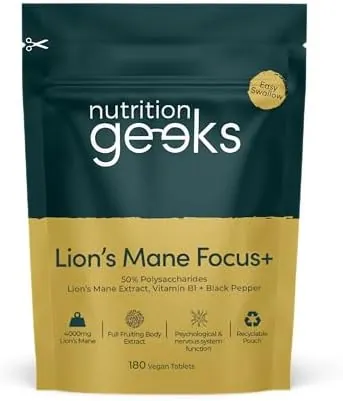
Lions Mane Supplement 4000mg with Vitamin B1 & Black Pepper, 180 Vegan Tablets - Lion's Mane Mushroom 15:1 Extract (Not Lions Mane Powder or Capsules), UK Made for Mental Performance & Nervous System
Check interactions with your other supplements
Add Lion's Mane to our interactive Stack Analyzer and see how it works with everything else you take.
Add Lion's Mane to your stack →Related Ingredients
Frequently Asked Questions
Fruiting body extracts are derived from the mushroom itself and contain higher concentrations of hericenones and beta-glucans — the primary bioactive compounds studied in clinical research. Mycelium-on-grain products are cultivated on rice or oats; the resulting powder often contains a substantial proportion of starch filler with lower concentrations of active compounds. When assessing product quality, look for a declared beta-glucan content (typically 20–30% in reputable extracts) rather than relying solely on total mushroom weight.
The primary clinical trial (Mori et al., 2009) observed statistically significant improvements in cognitive function after 16 weeks of continuous supplementation at 3 g/day. This suggests Lion's Mane may require sustained use over several months rather than producing immediate effects. Individual responses may vary depending on extract quality, dose, and baseline neurological status. No short-term trials of less than four weeks have demonstrated clinically meaningful cognitive outcomes in humans.
Published trials have not reported significant adverse effects at doses up to 3 g/day, and Lion's Mane is generally considered well tolerated. Some individuals report mild gastrointestinal discomfort, particularly at higher doses. Those with known mushroom or mould allergies should exercise caution. Research suggests potential interactions with anticoagulant medications are theoretically possible given observed antiplatelet activity in animal studies, though human data is limited. Consulting a GP before combining with prescription medications is advisable.