Important: This page is for informational purposes only, based on published peer-reviewed research and official UK dietary guidelines (NHS, EFSA, SACN). It does not constitute medical advice. Always consult your GP or pharmacist before starting, stopping, or combining supplements.
Turmeric / Curcumin and Vitamin D3 — Can You Take Them Together?
Overview
Curcumin — the primary bioactive polyphenol in turmeric (Curcuma longa) — and cholecalciferol (Vitamin D3) are two of the most extensively studied supplements available in the UK. Individually, each has been investigated for roles in modulating inflammatory responses and supporting immune function. Research suggests their combination may offer complementary anti-inflammatory effects through distinct but potentially synergistic signalling mechanisms. A 2021 clinical study found co-administration reduced pro-inflammatory cytokines more effectively than either compound alone. Individual responses may vary, and neither supplement substitutes for medical care.
How They Interact
Curcumin exerts anti-inflammatory activity primarily by inhibiting nuclear factor kappa-B (NF-kB), a transcription factor governing expression of pro-inflammatory cytokines including TNF-α, IL-1β, and IL-6. It also suppresses cyclooxygenase-2 (COX-2) and modulates JAK/STAT and MAPK kinase cascades, as reviewed by Panaro et al. (Inflammopharmacology, 2019; PMID 31140036). Vitamin D3, converted in the body to its active hormonal form calcitriol (1,25-dihydroxycholecalciferol), acts through vitamin D receptors (VDR) expressed on dendritic cells, macrophages, and T-lymphocytes. A randomised controlled trial demonstrated that D3 supplementation significantly modulated CD4+ T-cell activation in humans (Journal of Clinical Endocrinology & Metabolism, 2016; PMID 26653112). Crucially, curcumin and D3 operate on largely non-overlapping signalling nodes — curcumin acts upstream at transcription factor level, whilst D3 signals through nuclear receptor-mediated gene expression. This mechanistic divergence is why their combined effects may be additive rather than redundant. A 2021 clinical study found the curcumin and Vitamin D3 combination significantly reduced TNF-α and IL-2 levels in human patients compared to either compound alone (Frontiers in Neurology; PMID 33633656).
Timing & Dosage Guidance
Both curcumin and Vitamin D3 are fat-soluble compounds, which substantially influences their absorption. Curcumin's notoriously poor oral bioavailability — extensively documented in peer-reviewed literature (Anand et al., Molecular Pharmaceutics, 2007; PMID 17999464) — is meaningfully improved when taken alongside dietary fat. Vitamin D3 similarly requires bile salts and dietary lipids for optimal micellar absorption in the small intestine. Research suggests co-administration with the largest fat-containing meal of the day (typically lunch or dinner) is a practical strategy for both. There is no published evidence of a timing conflict between the two. Those using phospholipid-complexed curcumin preparations such as Meriva may achieve improved absorption even with lighter meals.
The NHS advises UK adults not to exceed 25 mcg (1,000 IU) of Vitamin D3 daily from supplements without medical supervision, whilst SACN's 2016 report sets 10 mcg (400 IU) as the reference nutrient intake for the general population. Higher doses — up to 4,000 IU — have been used in clinical trials. For curcumin, no EFSA-established daily reference intake exists; studied doses typically range from 500–2,000 mg/day of standardised curcumin extract. A 2024 human RCT used a curcumin-piperine formulation alongside Vitamin D3 and reported favourable inflammatory outcomes (Current Rheumatology Reviews; PMID 38299416). When combining both, no dose adjustment appears necessary based on current evidence; those on anticoagulant or immunosuppressive medications should seek guidance from a healthcare professional.
Recommended Action
Both can be taken with a fat-containing meal. The fat improves absorption of both curcumin and Vitamin D3.
Turmeric / Curcumin Timing
When: Any
Note: Fat-soluble — take with food and fat. Piperine (black pepper extract) increases absorption by up to 2,000%. Avoid within 2 hours of medication.
Vitamin D3 Timing
When: Morning
Note: Fat-soluble — better absorbed with a meal containing dietary fat
Scientific Evidence
4 peer-reviewed studies cited. All links lead to PubMed abstracts.
Frontiers in Neurology (2021) · PMID: 33633656
A combination including curcumin and Vitamin D3 significantly reduced TNF-α, IL-2, and PDGF-AB concentrations in human vitreous fluid, with the combined formulation outperforming individual compounds.
Arthritis Research & Therapy (2021) · PMID: 33494792
Bioavailable curcumin combined with Vitamin D3 reduced arthritis severity by over 80% and suppressed TNF, IFN-γ, and MCP-1 more than twofold compared to curcumin alone in a collagen-induced arthritis mouse model.
Current Rheumatology Reviews (2024) · PMID: 38299416
In a human RCT, Vitamin D3 combined with curcumin-piperine produced superior reductions in disease activity scores, fatigue severity, and pro-inflammatory cytokine profiles compared to either supplement used alone.
Inflammopharmacology (2019) · PMID: 31140036
Curcumin inhibits multiple inflammatory signalling molecules — including NF-kB, JAK/STATs, and MAPKs — providing the mechanistic basis for its complementary action alongside Vitamin D3's distinct nuclear receptor-mediated pathway.
Frequently Asked Questions
Current evidence does not indicate any adverse interaction between curcumin and Vitamin D3 at typical supplement doses. A 2024 randomised clinical trial found the combination was well-tolerated whilst producing improved inflammatory outcomes compared to placebo (PMID 38299416). Individual responses may vary, particularly for those with existing health conditions or taking prescription medications. If in doubt, a consultation with a GP or pharmacist is advisable.
No published clinical evidence suggests curcumin meaningfully interferes with Vitamin D3 absorption at standard supplement doses. Both compounds rely on dietary fat for optimal uptake, making co-administration with meals convenient. Some preclinical data indicate curcumin may influence cytochrome P450 enzymes involved in Vitamin D metabolism; however, the clinical relevance at typical supplemental doses has not been demonstrated in human trials and remains an area for further research.
Curcumin bioavailability varies considerably by formulation. Phospholipid-complexed forms (e.g., Meriva), micellar preparations (e.g., Theracurmin), and standardised extracts combined with piperine all demonstrate superior absorption compared to standard curcumin powder. A 2021 preclinical study used a bioavailable curcumin preparation alongside Vitamin D3 and reported markedly enhanced anti-inflammatory effects (Arthritis Research & Therapy; PMID 33494792), indicating that formulation choice may meaningfully influence the utility of this combination.
Top Turmeric / Curcumin Products on AIScored
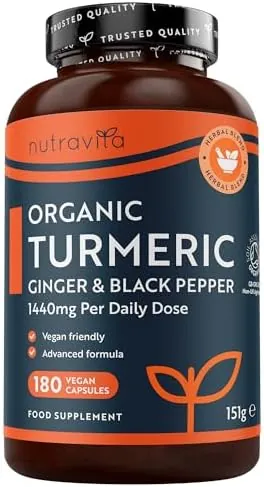
Nutravita Organic Turmeric 1440mg (High Strength) with Black Pepper & Ginger - 180 Vegan Turmeric Capsules (3 Month Supply) – Organic Termeric with Active Ingredient Curcumin - Made in The UK
Top Vitamin D3 Products on AIScored
Want to check more interactions?
Add these and other supplements to our interactive Stack Analyzer for a full analysis.
Build your full stack →